


UK Installation, DNO & Backup Power Guide
Product & App
UK guidance on PowerFlex installation, electricians, DNO approval, G98, G99, G100 and backup power.
Installing a Home Battery in the UK: Electricians, DNO, G98, G99 & Backup Power
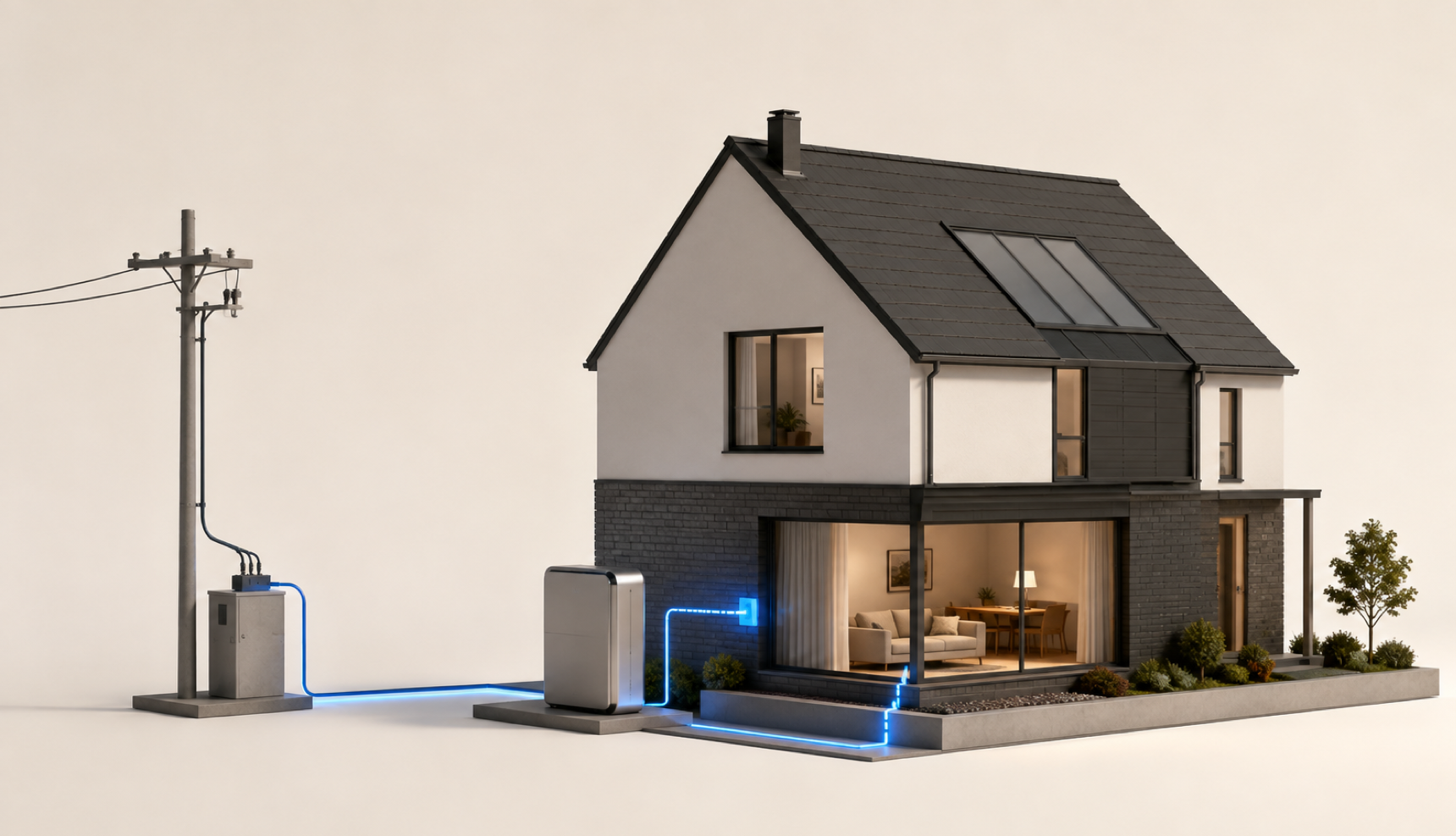
Installing home battery storage involves more than choosing the right battery.
Your electrical installation, existing solar system, local electricity network and proposed system capacity all affect how your system should be installed and registered.
Here is what you need to know before installing an Indevolt PowerFlex system in the UK.
Do I need an electrician?
For an Indevolt system connected to your home's electrical installation, use a suitably qualified electrician with experience in battery storage, solar and bidirectional energy systems.
Professional installation is especially important where the work involves:
• A new dedicated circuit
• Changes to your consumer unit
• Fixed electrical wiring
• Solar PV integration
• Battery export
• Multiple battery or inverter systems
• Backup power equipment
• Export limitation equipment
In England, Part P of the Building Regulations covers electrical safety in dwellings. New circuits and consumer-unit replacements fall within notifiable electrical work.
Requirements differ between England, Wales, Scotland and Northern Ireland. Your installer should follow the rules applying to your property.
What is BS 7671?
BS 7671, commonly known as the IET Wiring Regulations, sets the requirements for electrical installations in the UK.
Battery storage connected to a property forms part of its electrical installation.
BS 7671:2018+A4:2026 was published in April 2026 and includes requirements covering stationary secondary batteries used for electrical energy storage and supply.
Your electrician should design, install, inspect and test your system against the edition of BS 7671 applying when the work takes place.
What is a DNO?
Your Distribution Network Operator, or DNO, manages the local electricity network serving your property.
Your DNO is different from your electricity supplier.
Your electricity supplier sells you electricity and manages your tariff. Your DNO operates the local cables, substations and infrastructure carrying electricity to and from your property.
When solar generation or battery storage operates in parallel with the electricity network, grid connection requirements apply.
For most residential installations, the main connection standards are G98 and G99. G100 also becomes relevant where an export limitation scheme forms part of the installation.
What is G98?
G98 provides a connection route for qualifying Fully Type Tested small-scale generation.
For a standard single-phase installation, the G98 threshold is 16A per phase, equivalent to 3.68 kW at nominal UK voltage.
For three-phase installations, this equates to 11.04 kW overall, subject to the 16A limit on each phase.
Battery storage forms part of this assessment.
For qualifying G98 installations, the system is normally commissioned first and the required information is then submitted to the DNO within the required notification period.
This process is often described as "install and notify."
Does the 3.68 kW limit only apply to my new battery?
No.
Your installer needs to assess the complete installation at the property's connection point.
Existing solar generation matters.
For example:
Existing solar inverter: 3.0 kW
New battery inverter: 3.0 kW
Combined capacity: 6.0 kW
You should not treat this as a simple 3.0 kW installation without assessing the existing equipment.
Adding another battery or inverter does not automatically provide another 3.68 kW G98 allowance.
Your installer should review all existing and proposed generation and storage before selecting the appropriate DNO connection route.
What is G99?
G99 covers generation and storage arrangements outside the standard G98 route.
Where G99 applies, your installer normally submits the relevant information to the DNO before installation and commissioning.
The DNO assesses the proposed system and local network.
This assessment includes factors such as:
• Existing solar generation
• Existing battery storage
• New inverter capacity
• Maximum potential export
• Network capacity
• Protection settings
• Single-phase or three-phase supply
• Export limitation
• The proposed electrical arrangement
The DNO then confirms the connection requirements for the property.
Your electrician or installation provider should establish the appropriate G98 or G99 route before work starts.
What if I already have solar panels?
Tell your installer before ordering or installing additional equipment.
An existing solar PV system forms part of the overall connection assessment.
Your installer should check:
• Existing inverter capacity
• Existing DNO approval or notification
• Proposed PowerFlex configuration
• Maximum possible export
• Supply type
• Existing battery equipment
• Any export limitation already installed
A home with an existing 3.68 kW solar inverter needs a different assessment from a property with no existing generation.
What is G100?
G100 covers export limitation schemes.
An export limitation scheme controls the maximum amount of electricity exported from your property into the public network.
Your total generation and storage capacity might exceed the export level agreed with your DNO. An appropriate export limitation system restricts grid export to the agreed level.
G100 does not automatically move an installation from G99 into G98.
Your installer should determine whether G100 forms part of the connection arrangement for your property.
What happens during a power cut?
A standard grid-connected solar or battery inverter must respond safely when the public electricity network fails.
The system must stop energising the public network during an outage.
This protects engineers working on the local network and prevents electricity from your property feeding back into lines expected to be isolated.
Backup power works differently.
A correctly designed backup system separates its backup supply from the failed public network before providing power to supported loads.
How does PowerFlex 3000 backup power work?
PowerFlex 3000 includes a dedicated off-grid AC output for backup use.
During a mains outage, supported equipment connected through the appropriate backup arrangement draws power from the battery without feeding electricity back into the public network.
Backup loads might include:
• Internet routers
• Computers
• Lighting
• Refrigeration
• Phones and chargers
• Selected household appliances
The available backup capacity depends on your PowerFlex configuration, battery state of charge and connected electrical load.
Backup power does not mean every circuit in your property stays powered during an outage.
Your installer should design the backup arrangement around the equipment you want to keep running.
What happens when grid power returns?
Once a stable grid supply returns, the system follows its protection and reconnection settings before returning to normal grid-connected operation.
PowerFlex then resumes its normal energy management strategy based on your configuration, battery charge level, solar generation and electricity tariff settings.
What about plug-in solar?
The UK has been developing a separate framework for qualifying plug-in solar products.
Battery storage needs separate consideration.
Do not assume rules covering small plug-in solar products remove electrical installation, BS 7671 or DNO requirements for a PowerFlex battery installation.
Your installer should assess the complete system under the requirements in force when your system is installed.
Your UK installation process
- Review your property and existing electrical equipment.
- Identify any existing solar, battery or generation systems.
- Confirm whether your electricity supply is single-phase or three-phase.
- Confirm your proposed PowerFlex configuration.
- Have your installer determine the appropriate G98, G99 and, where relevant, G100 route.
- Complete any required DNO application or notification.
- Install and commission the system to the applicable electrical requirements.
- Complete the required electrical and DNO documentation.
- Configure grid-connected operation, energy management and backup power.
- Keep your installation and DNO documents for future reference.
A smarter installation starts with the right assessment
Every property is different.
Existing solar, battery capacity, inverter ratings, electrical supply and local network conditions all influence the correct installation route.
Before installing PowerFlex, have a suitably qualified installer assess your existing system and confirm the electrical and DNO requirements for your property.
This gives your PowerFlex system the right foundation for safe grid operation, smart energy management and backup power when you need it.
View Hardware and Installation Guides
